
Quit Smoking Timeline: What Happens Hour by Hour to Year 15
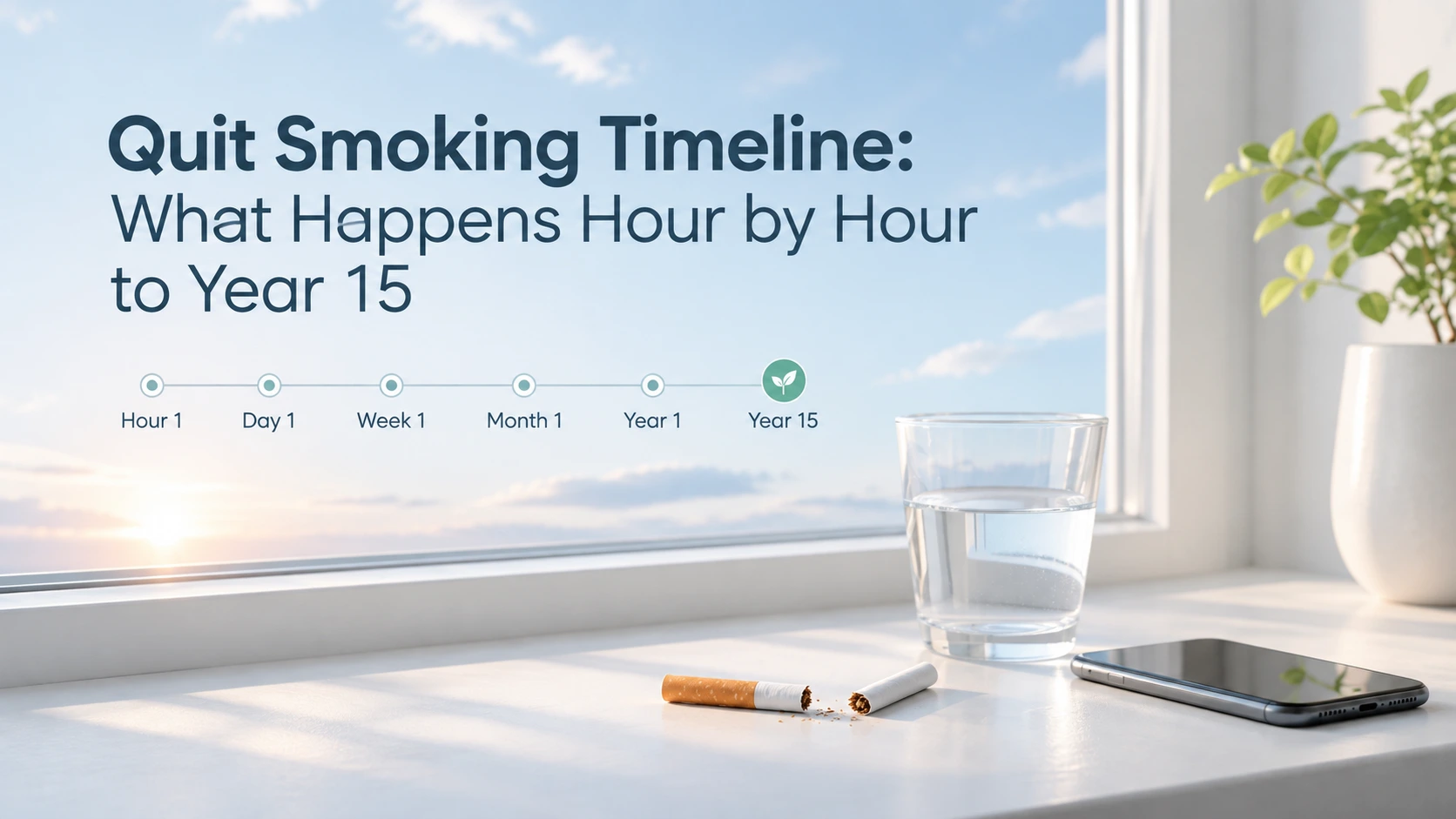
When you quit smoking, recovery starts within minutes. Your heart rate drops after about 20 minutes, carbon monoxide in your blood returns to normal within 12 hours, and breathing gets easier after 3 days. After 1 year your heart disease risk is about half that of a smoker, and after 15 years it matches a non-smoker’s.
The quit smoking timeline at a glance
- 20 minutes: heart rate and blood pressure drop.
- 8 hours: carbon monoxide and nicotine levels in the blood fall by half.
- 12 hours: carbon monoxide in the blood returns to normal.
- 24 hours: nicotine in the blood drops to zero.
- 48 hours: taste and smell start to improve.
- 72 hours: breathing gets easier and energy levels rise.
- 2 to 12 weeks: circulation and lung function improve.
- 1 to 9 months: coughing and shortness of breath decrease.
- 1 year: coronary heart disease risk is about half that of a smoker.
- 5 to 15 years: stroke risk falls to that of a non-smoker.
- 10 years: lung cancer risk is about half that of a smoker.
- 15 years: coronary heart disease risk is the same as a non-smoker’s.
The milestones come from the World Health Organization, the CDC and NHS Cardiff and Vale. They are averages: how fast your body recovers depends on how long and how much you smoked, and on your overall health. The sections below explain each stage.
The first 72 hours: what happens hour by hour
20 minutes after your last cigarette
Nicotine raises heart rate and blood pressure. According to the WHO, both start to drop within 20 minutes of your last cigarette. It is the first measurable change, and it happens before most people even feel a craving.
8 to 12 hours: carbon monoxide clears
Cigarette smoke carries carbon monoxide, a gas that takes the place of oxygen in your red blood cells. NHS Cardiff and Vale notes that carbon monoxide and nicotine levels halve after about 8 hours, and the WHO says carbon monoxide returns to normal within 12 hours. With less of it in your blood, more oxygen reaches your heart and muscles.
24 hours: nicotine leaves your blood
The CDC states that nicotine in the blood drops to zero within 24 hours. This is also when withdrawal starts to show: cravings, irritability and restlessness are your brain adjusting to the missing nicotine, not a sign that something is wrong.
48 to 72 hours: taste, smell and breathing
After 48 hours, taste and smell begin to recover. By 72 hours, breathing gets easier and energy levels rise, according to NHS Cardiff and Vale. For many people, the first few days are also the hardest for cravings, so plan this stretch in advance: keep busy, avoid your usual smoking triggers and have a plan for the moments when the urge hits.
Weeks 1 to 12: withdrawal fades, circulation improves
Between 2 and 12 weeks, the WHO reports that circulation improves and lung function increases. Walking, climbing stairs and exercise often start to feel easier in this period.
When do nicotine withdrawals peak?
According to Smokefree.gov, run by the US National Cancer Institute, withdrawal symptoms are strongest in the first few days or weeks, and the worst of them last from a few days to a couple of weeks. Common symptoms include:
- strong cravings to smoke;
- irritability, frustration or anxiety;
- restlessness and trouble concentrating;
- trouble sleeping;
- more appetite.
Our guide to smoking withdrawal symptoms covers each symptom, how long it lasts and what helps. A single craving usually passes within minutes, so the most useful skill is riding it out: drink water, step outside or keep your hands busy until it fades. Nicotine replacement and quit-smoking medicines can make this phase noticeably easier. If you are cutting down first instead of stopping all at once, our guide to quitting smoking gradually has a step-down plan.
Mood often improves too. The NHS notes that it can take as little as 6 weeks to start feeling the mental health benefits of stopping smoking.
Months 1 to 9: coughing and breathing
Between 1 and 9 months, the WHO says coughing and shortness of breath decrease. NHS Cardiff and Vale adds that between 3 and 9 months, lung function can increase by up to 10%.
Why you may cough more after quitting
Some people cough more in the first weeks, not less. As Mayo Clinic explains, smoke damages the cilia, the tiny hairs that sweep mucus out of your airways. Once you quit, they grow back and start clearing what has built up, and that can trigger coughing. It is usually a sign of recovery and tends to go away on its own.
What color is phlegm after quitting smoking?
There is no single “right” color. Most of what you cough up is mucus that your recovering airways are finally clearing. Mayo Clinic advises seeing a doctor if the cough lasts more than a month or if you cough up blood. It is also worth getting checked if the phlegm turns green or yellow along with a fever, or if you feel more short of breath, since these can point to an infection rather than normal recovery.
Year 1 to year 15 and beyond: long-term risk
The long-term benefits are where quitting has the biggest effect. Combining the WHO and CDC timelines:
- 1 year: the risk of coronary heart disease is about half that of a smoker. The CDC says the risk of heart attack drops sharply within 1 to 2 years.
- 3 to 6 years: the added risk of coronary heart disease drops by half.
- 5 to 10 years: the added risk of cancers of the mouth, throat and voice box drops by half, and stroke risk decreases.
- 5 to 15 years: stroke risk falls to that of a non-smoker.
- 10 years: lung cancer risk is about half that of a smoker, and the risk of cancers of the bladder, esophagus and kidney decreases.
- 15 years: the risk of coronary heart disease is the same as a non-smoker’s.
- 20 years: the risk of cancers of the mouth, throat, voice box and pancreas drops close to that of a non-smoker, and the added risk of cervical cancer drops by about half.
Is it ever too late to quit?
No. The WHO estimates that, compared with people who keep smoking, those who quit around age 30 gain almost 10 years of life expectancy, around 40 about 9 years, around 50 about 6 years and around 60 about 3 years. People who already have smoking-related heart disease still benefit: quitting reduces their risk of another heart attack.
How to keep track of your progress
A timeline is easier to follow when you can see where you are on it. Smoke Off counts your smoke-free days and the cigarettes you have avoided, and shows which health milestones you have reached so far. On hard days, seeing how far you have come is a good reason not to restart the clock.
Your last cigarette is closer than you think.
Set your first goal in under 2 minutes and start smoking less today, at your own pace.
Frequently asked questions
What happens to your body when you quit smoking?
Recovery starts within minutes. According to the WHO, heart rate and blood pressure drop after 20 minutes, carbon monoxide in the blood returns to normal within 12 hours, circulation and lung function improve within 2 to 12 weeks, and coughing decreases within 1 to 9 months. After 1 year, coronary heart disease risk is about half that of a smoker.
When do nicotine withdrawals peak?
Smokefree.gov says withdrawal symptoms are strongest in the first few days or weeks after quitting, and the worst of them last a few days to a couple of weeks. Cravings and other symptoms fade over time as long as you stay smoke-free.
What color is phlegm after quitting smoking?
There is no single normal color: most of it is mucus your recovering airways are clearing. See a doctor if the cough lasts more than a month or you cough up blood (Mayo Clinic), or if the phlegm turns green or yellow with a fever.
How long does it take for your lungs to recover after quitting smoking?
Lung function starts improving within 2 to 12 weeks (WHO), and coughing and shortness of breath decrease within 1 to 9 months. Lung cancer risk falls to about half that of a smoker after 10 years.
Is it too late to quit smoking after 50?
No. The WHO estimates that people who quit around age 50 gain about 6 years of life expectancy compared with those who keep smoking, and about 3 years if they quit around 60.
Sources
- World Health Organization, Tobacco: health benefits of smoking cessation (2020)
- CDC, Benefits of Quitting Smoking (2024)
- Cardiff and Vale University Health Board (NHS Wales), Reasons to Quit Smoking
- NHS Better Health, Benefits of quitting smoking
- National Cancer Institute, Smokefree.gov, Understanding Withdrawal
- Mayo Clinic, Coughing more after quitting smoking: What’s the deal?
This article is for information only and is not a substitute for medical advice. If you have a health condition, are pregnant or have symptoms that worry you, talk to your doctor.